REPORT ON THE ONE-DAY BASIC TRAINING PROGRAMME ON “ACCESS TO SOCIAL JUSTICE AND HUMAN RIGHTS: ENSURING EQUALITY FOR ALL”
Organised by: Faculty of Law, Swami Vivekanand Subharti University, Meerut
Sponsored by: National Human Rights Commission (NHRC), New Delhi
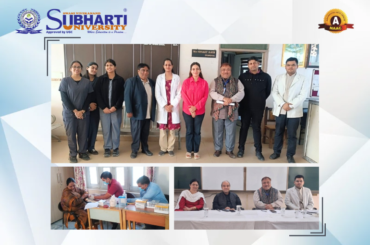
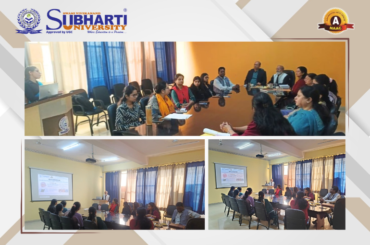
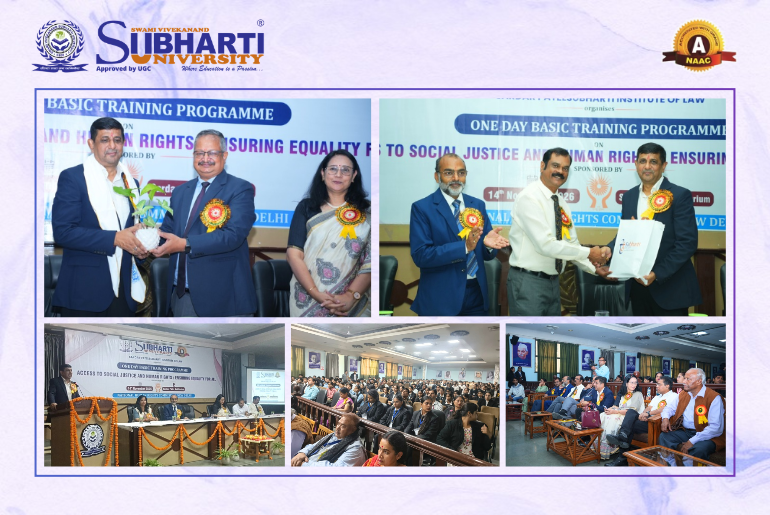
The Faculty of Law, Swami Vivekanand Subharti University, Meerut, is organising a One-Day Basic Training Programme on “Access to Social Justice and Human Rights: Ensuring Equality for All”, sponsored by the National Human Rights Commission (NHRC), New Delhi, on 14 November 2026. The programme aims to promote awareness and understanding of human rights, constitutional and international frameworks, equality, social justice, and the protection of vulnerable and marginalised sections of society. It has been designed to provide participants with comprehensive academic insights into various dimensions of human rights and to sensitise them to the importance of constitutional values, legal safeguards, and institutional mechanisms for the protection and promotion of human right.The inaugural ceremony included the administration of the Human Rights Oath by the Hon’ble Vice-Chancellor of Swami Vivekanand Subharti University. Through the oath, participants reaffirmed their collective commitment to upholding human dignity, equality, justice, liberty, and the protection and promotion of human rights. It also emphasised the responsibility of every individual to respect the rights of others and contribute towards the creation of an inclusive, just, and equitable society.
The first expert session was delivered by Prof. (Dr.) Manoj Kumar Sinha, Vice-Chancellor, Dharmashastra National Law University, Jabalpur, on the theme “Human Rights, Equality and Social Justice: Constitutional and International Framework.” The session addressed the meaning and concept of human rights, human dignity, equality and non-discrimination, and the relationship between human rights, equality, and social justice. It also covered constitutional provisions relating to human rights and equality in India, the Universal Declaration of Human Rights, 1948, and international covenants concerning human rights. The deliberations provided participants with valuable insights into the constitutional and international foundations of human rights and their significance in ensuring dignity, equality, and justice for every individual.
The second expert session was delivered by Prof. (Dr.) Vageshwari Deswal, Professor, Law Centre-II, Faculty of Law, University of Delhi, on the theme “Rights of Vulnerable and Marginalised Groups: Equality, Protection and Access to Justice.” The session focused on the legal and institutional safeguards available for the protection of vulnerable and marginalised sections of society. Particular emphasis was placed on the rights of women and children, along with those of other vulnerable and marginalised groups. The deliberations highlighted the importance of equality, access to justice, and the responsibility of various stakeholders in ensuring the effective protection of human rights. The session also sensitised participants to the challenges faced by disadvantaged communities and the need to strengthen legal awareness, institutional accountability, and protective mechanisms.
The third academic session is delivered by Dr. Vinai Kumar Singh, Associate Professor, Jawaharlal Nehru University, New Delhi, on the theme “Promoting Understanding of Social Justice as a Fundamental Human Right and Promoting SDG 16 (Peace, Justice and Strong Institutions).” This session covered the Protection of Human Rights Act, 1993, the composition and functioning of the National Human Rights Commission and State Human Rights Commissions, the role of other national and state human rights institutions, and institutional mechanisms for the protection of human rights. It will further address access to justice, institutional remedies, and the role of citizens and civil society in reporting and addressing human rights violations. The session provided valuable insights into the institutional framework for the protection and promotion of human rights in India.
Thereafter, the fourth academic session delivered by Dr. Vaibhav Goel Bhartiya, Professor and Dean, Research and Development Cell, Swami Vivekanand Subharti University, Meerut, on the theme “From Human Rights to Social Justice: Access, Remedies and Action Planning.” The session focus on identifying human rights violations and the appropriate authorities and institutions for redressal, access to legal aid and other support mechanisms, grievance redressal and referral mechanisms, and the role of communities, institutions, and civil society in promoting social justice. It also addresses practical barriers to accessing justice through a case-based exercise on identifying appropriate remedies and institutional responses. The session provide participants with a practical understanding of translating human rights principles into effective action and ensuring accessible remedies for individuals whose rights have been violated.
Following the fourth academic session, the programme end with the concluding session, conducted by Prof. (Dr.) Reena Bishnoi, Professor and Dean, Faculty of Law, Swami Vivekanand Subharti University, Meerut. The academic sessions conducted so far have provided valuable insights into human rights from constitutional, international, and social justice perspectives. The programme, as a whole, seeks to strengthen awareness of human dignity, equality, non-discrimination, social justice, and access to effective legal remedies, while encouraging participants to recognize their individual and institutional responsibilities in protecting human rights, particularly those of vulnerable and marginalised communities. The One-Day Basic Training Programme represents a significant academic initiative undertaken by the Faculty of Law, Swami Vivekanand Subharti University, Meerut, with the sponsorship of the National Human Rights Commission, New Delhi. With the successful completion of its first two academic sessions and the remaining sessions scheduled to follow, the programme is progressing as per its academic schedule. Through the participation of eminent resource persons and structured academic deliberations, the initiative seeks to contribute towards strengthening the culture of human rights, promoting constitutional values, and advancing the objectives of equality, liberty, dignity, and justice for all.