“Ek Din, Ek Ghanta, Ek Saath” Cleanliness Activity Conducted at BCSCHM
Meerut | 1 October 2026
Bhikaji Cama Subharti College of Hotel Management (BCSCHM), Swami Vivekanand Subharti University, Meerut, organized “Ek Din, Ek Ghanta, Ek Saath” – Cleanliness Activity on 1 October 2026 as part of the Swachhata Hi Seva (SHS) Campaign 2026. The activity was conducted from 3:00 PM to 4:00 PM at the college premises.
The initiative focused on promoting cleanliness, hygiene, environmental responsibility, and sustainable campus practices. It encouraged students and faculty members to participate actively in maintaining a clean and hygienic institutional environment and reinforced the idea that cleanliness is a shared responsibility.
A total of 13 participants, comprising 8 students and 5 faculty members, took part in the activity. The programme was coordinated by Dr. Garima Jain and Mr. Rohil Bhatnagar.
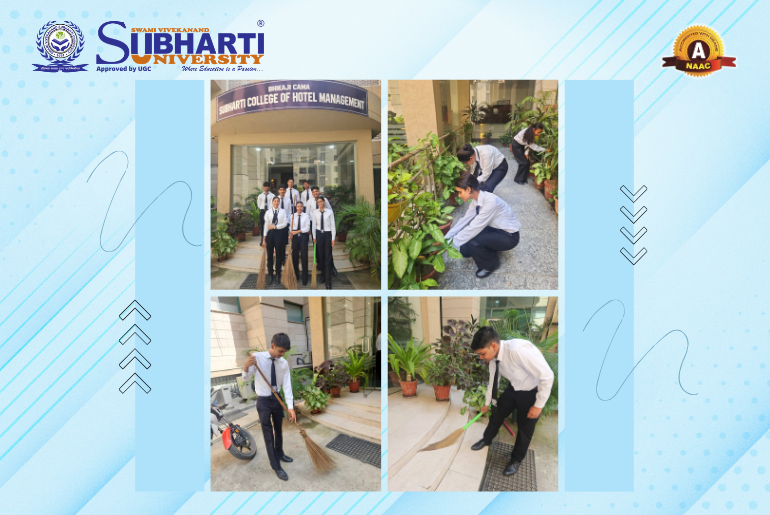
During the activity, participants collectively undertook cleanliness-related activities across the college premises. Students and faculty members actively participated in cleaning and maintaining different areas of the campus, including outdoor spaces and common areas. The activity provided students with practical exposure to community-oriented environmental responsibility beyond their routine academic activities.
The geotagged photographs included in the activity report visually document students participating in the cleanliness drive. The photographs show participants cleaning landscaped areas, sweeping campus surroundings, maintaining plant areas, and undertaking cleaning activities within the college premises. The images also document the participation of students in formal college attire during the activity.
The activity successfully promoted awareness of cleanliness, hygiene, environmental responsibility, and sustainable campus practices among the participating students and faculty members. The joint participation of students and faculty reinforced the importance of collective action in maintaining a clean educational environment.
The programme also encouraged participants to view cleanliness as an ongoing institutional responsibility rather than a one-time activity. Faculty participation alongside students further demonstrated the collective nature of environmental responsibility and campus hygiene.
The initiative contributed to the institution’s broader objectives of holistic student development, social responsibility, environmental awareness, and sustainable campus practices. It also complemented the objectives of the Swachhata Hi Seva Campaign 2026 by encouraging direct participation in maintaining a cleaner and more hygienic institutional environment.
The activity highlighted the importance of participatory cleanliness initiatives in creating healthy learning environments and developing responsible environmental behaviour among students. Regular cleanliness drives, waste-segregation awareness, responsible waste disposal, reduction of single-use materials, and collective monitoring of campus hygiene were identified as potential measures for sustaining the initiative.