Ganga Pustak Parikrama Organized by the Department of Languages, Faculty of Arts and Social Sciences, Subharti University
“Ganga is deeply rooted in the heart and soul of Indian culture” – Anil Kumar Gandhi, Historian
“The essence of Indian culture is embedded in the Ganga” – Dr. Ramgopal Bhartiya, Renowned Author
A special event, Ganga Pustak Parikrama, was organized under the joint auspices of the Department of Languages, Faculty of Arts and Social Sciences, Faculty of Fine Arts, Swami Vivekananda Subharti University, and the National Book Trust, Ministry of Education, Government of India.
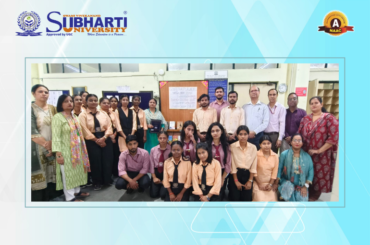
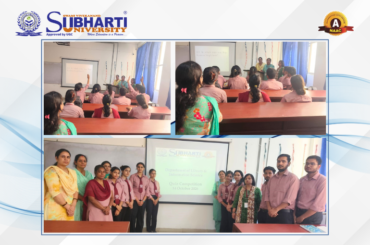
On this occasion, a seminar on the theme “Ganga Through the Ages” was held. A book exhibition and art exhibition focusing on the importance and cleanliness of the Ganga were also showcased. Participants also explored a wide range of books available in the Van Library brought by the National Book Trust.
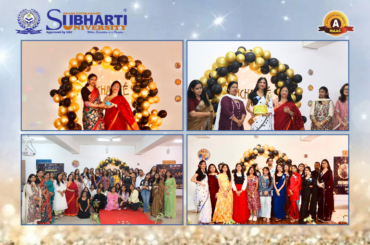
The event commenced at Satyajit Ray Auditorium with the ceremonial lamp lighting by eminent historian Anil Kumar Gandhi, noted author Dr. Ramgopal Bhartiya, Vice-Chancellor Maj. Gen. (Dr.) G.K. Thapliyal, Pro Vice-Chancellor Col. Devendra Swaroop, Dean of Faculty of Arts and Social Sciences Dr. Sudhir Tyagi, Prof. Dr. Rahul Bansal (Department of Community Medicine, Subharti Medical College), Head of Department of Languages Dr. Seema Sharma, and Dr. Pintu Mishra.
Vice-Chancellor Maj. Gen. (Dr.) G.K. Thapliyal expressed his gratitude to the National Book Trust and emphasized that books are the guardians of our culture and civilization. Quoting Lord Buddha, he stated, “Ignorance is the root of suffering, and acquiring knowledge through books is essential.” He remarked that Ganga holds supreme importance in Indian culture, representing both purity and pride. Wherever the Ganga flows, it becomes a spiritual center. He extended his best wishes for the success of the Ganga Pustak Parikrama and led the gathering in taking a pledge to keep the Ganga clean and pure.
Renowned writer Dr. Ramgopal Bhartiya shared that every place touched by the Ganga becomes a pilgrimage. He elaborated that pilgrimage signifies purity, compassion, and sacred intent. The Ganga is deeply embedded in Indian culture; along its banks, sages, seers, and great personalities composed the Vedas and worked for the welfare of humanity. The Ganga is not merely a river but a center of faith and life.
Historian Anil Kumar Gandhi discussed the structure of books, the existence of the Ganga, and its historical dimensions. He asserted that the soul of a book lies in its ideas—ideas that are creative, factual, and authentic. Scientifically, Ganga water possesses germicidal properties, while religiously, it is considered akin to nectar. He described the Ganga not just as a river but as a living symbol of India’s heart, faith, and culture—more than a river, she is a mother, goddess, and the soul of civilization. He also highlighted that the National Book Trust, India is conducting this Ganga Pustak Parikrama to raise awareness for the protection of the Ganga.
Mr. Kuldeep, Project Head of Ganga Pustak Parikrama, informed that the National Book Trust is working towards the conservation of the Ganga and raising awareness through literature. The trust emphasizes reading so that people can understand the culture and knowledge of the nation and the world.
Prof. Dr. Rahul Bansal, from the Department of Community Medicine, spoke on the spiritual and scientific significance of the Ganga. He also sang devotional songs related to the Ganga, creating a spiritually charged atmosphere. He stressed that books are key to awareness, and today’s youth are increasingly stressed due to excessive use of mobile phones and the internet. He encouraged the cultivation of reading habits for personal growth and mental peace.
The Subharti family presented mementos to the representatives of the National Book Trust and other esteemed guests as a mark of respect and appreciation.
The stage was anchored by Vidhhi Goswami, a student of MA English, and the vote of thanks was delivered by Dr. Seema Sharma, the event convener. The event concluded with the singing of “Vande Mataram”. Students and faculty members from various departments and faculties of the university were present on the occasion.