Educational Visit to Amrit Udyan, Rashtrapati Bhawan
Date: 14 March 2026
Organized by: Department of Liberal Arts and Humanities, Faculty of Arts & Social Sciences, Swami Vivekanand Subharti University, Meerut
Educational visits play a vital role in bridging the gap between theoretical knowledge and practical exposure. Keeping this objective in mind, the Department of Liberal Arts and Humanities organized an educational visit to Amrit Udyan, located within the premises of Rashtrapati Bhavan, New Delhi. The visit aimed at providing students with an opportunity to experience the intersection of governance, heritage, environmental sustainability, and ecological diversity in a real-world setting.
Objectives of the Visit
The visit was conducted with the following academic and experiential objectives:
- To provide experiential learning opportunities beyond classroom teaching.
- To develop an understanding of India’s constitutional and administrative institutions through exposure to Rashtrapati Bhavan.
- To promote awareness of biodiversity, environmental conservation, and sustainable horticulture.
- To analyze the relationship between governance, environment, and public spaces.
- To encourage appreciation of India’s cultural heritage and landscape architecture.
- To connect academic learning with the Sustainable Development Goals (SDGs).
- To foster observational, analytical, and critical thinking skills among students.
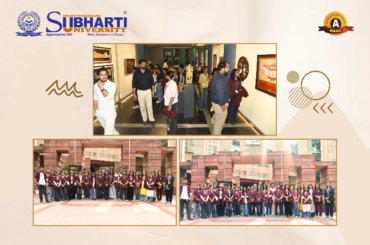
The educational visit was meticulously planned and coordinated by Dr. Amrita Chaudhary, Dr. Dinesh Kumar and Mr. Kapil Kumar The visit was attended by enthusiastic students including Kainat, Alish, Narayani, Jay, Ujjawal, Abhiraj, Karyik, and Loden, Tannu, Naman, Abhinav, Asi, Siya, Pragya, Khalid who actively participated in the learning process. Attendant Mr. Omendra Kumar and Bus Driver Mr. Ramkishan supported throughout the journey.
Summary of the Visit
The visit commenced with the departure of students and faculty members from the university campus by Hod Dr. Jyoti Gaur to New Delhi. Upon arrival at Rashtrapati Bhavan, students were introduced to the historical and political significance of the Presidential Estate. At Amrit Udyan, students explored various sections of the garden, each reflecting distinct horticultural themes and plant diversity. They observed a wide range of seasonal flowers, ornamental plants, medicinal herbs, and rare species. The layout of the garden, characterized by symmetrical patterns, terraces, water channels, and fountains, demonstrated the influence of Mughal garden architecture combined with modern ecological practices.
Students gained insights into:
- Sustainable landscaping and water management techniques
- Preservation of biodiversity in urban settings
- Role of green spaces in promoting environmental sustainability
- Integration of heritage conservation with modern governance
The visit also provided an opportunity to understand Rashtrapati Bhavan as a symbol of India’s democratic system. Discussions were held on the role of the President of India, constitutional values, and the functioning of key public institutions. The interactive and observational nature of the visit encouraged students to relate theoretical concepts from political science, environmental studies, and public administration to real-life applications.
Academic Relevance of the Visit
The visit holds strong interdisciplinary relevance:
- Political Science: Understanding the constitutional role of the President and institutional governance.
- Public Administration: Insight into administrative functioning and public space management.
- Environmental Studies: Awareness of biodiversity, sustainability, and conservation practices.
- Cultural Studies: Appreciation of India’s heritage and architectural traditions.
Outcomes of the Visit
The visit significantly contributed to achieving educational outcomes aligned with the United Nations Sustainable Development Goals (SDGs):
SDG 4: Quality Education
- Promoted experiential, field-based, and interdisciplinary learning.
- Enhanced critical thinking and analytical skills among students.
SDG 11: Sustainable Cities and Communities
- Highlighted the importance of sustainable urban planning and conservation of heritage sites.
- Encouraged students to value public spaces and cultural assets.
SDG 15: Life on Land
- Developed understanding of biodiversity conservation and ecological balance.
- Encouraged respect for plant life and natural ecosystems.
SDG 3: Good Health and Well-being
- Emphasized the importance of green spaces for mental relaxation and physical well-being.
By the end of the visit, students were able to:
- Relate theoretical concepts with practical observations.
- Understand the role of public institutions in governance and sustainability.
- Appreciate the significance of biodiversity and environmental conservation.
- Develop observational and analytical skills.
- Recognize the importance of sustainable development in policy and practice.
The educational visit to Amrit Udyan and Rashtrapati Bhavan proved to be highly enriching, informative, and intellectually stimulating. It successfully fulfilled its objectives by integrating academic knowledge with experiential learning.
The visit not only broadened the intellectual horizons of the students but also instilled a sense of environmental responsibility and civic awareness. The coordinated efforts of faculty members, staff, and students ensured the success of the program, making it a memorable and impactful learning experience.