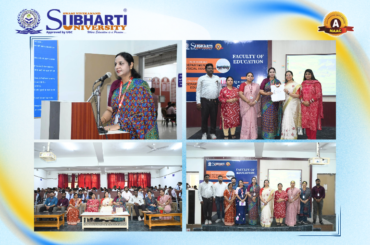
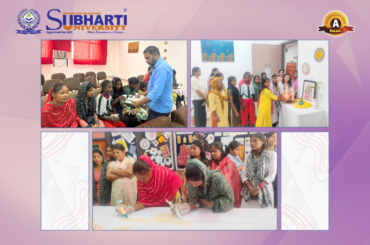
A seminar was organized at Swami Vivekanand Subharti University under the joint auspices of the Department of Journalism and Mass Communication and the Netaji Subhash Chandra Bose Chair to commemorate Moirang Day. During the event, a detailed discussion was held on the subject “Netaji Subhash Chandra Bose and the Historical Significance of Moirang.” Colonel Rajesh Tyagi (Retd.), Director of the Subharti Defense Academy, attended as the chief guest and keynote speaker. The program commenced with a floral tribute to the portrait of Netaji and the presentation of a sapling to the guest.
Addressing the gathering, Colonel Rajesh Tyagi stated that Moirang is not merely a geographical location but an inspiring chapter in the history of the Indian freedom struggle. He remarked that Netaji’s leadership and strategies continue to inspire the youth toward patriotism. Sharing his experiences, Colonel Tyagi noted that Moirang stands as a symbol showing that with passion, grit, and love for the nation, one can defeat the world’s greatest powers even in the most difficult terrains. He urged the youth of India to move forward with that same spirit to ensure the country becomes a developed nation by 2047.
Prof. Ashok Tyagi, Convener of the Netaji Subhash Chandra Bose Chair, expressed his views by stating that Moirang’s historical importance is special because it was a major center for the activities of the Azad Hind Fauj. He emphasized that it is vital for today’s youth to understand Netaji’s vision and his struggle. The seminar was coordinated by Dr. Preeti Singh, Research Officer of the Chair, who presented the program’s framework and highlighted the relevance of the topic.
Concluding the event, Prof. (Dr.) Ritesh Chaudhary, Head of the Department of Journalism and Mass Communication, delivered the vote of thanks. He remarked that such events connect students with history while developing a sense of national consciousness. He added that Netaji’s life and the significance of Moirang deliver a profound message of dedication to the country. The program was attended by a large number of faculty members, researchers, and students from the department.