
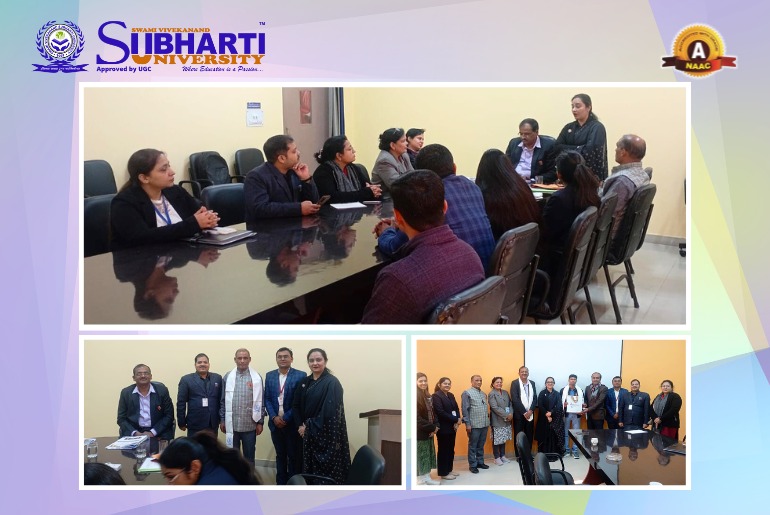
The Swami Vivekanand Chair at Swami Vivekanand Subharti University (SVSU) organized a Special Lecture on 6 December 2025 to commemorate Gita Jayanti, celebrating the timeless wisdom of the Bhagavad Gita and its relevance in addressing contemporary economic and ethical challenges. The event, centred on the theme “Relevance of the Bhagavad Gita in the Present Economic Scenario,” highlighted how ancient philosophical insights can offer valuable guidance for modern socio-economic systems, leadership models, and sustainable development.
The programme was conducted by Prof. (Dr.) Monika Mehrotra, Professor & Convener, Swami Vivekanand Chair, SVSU, who welcomed the distinguished guests, academicians, and participants. She was joined by Prof. (Dr.) Sudhir Tyagi, Dean, Faculty of Arts and Social Sciences (FASS), SVSU, whose presence added immense academic value to the occasion. In her inaugural address, Prof. Mehrotra emphasized the significance of integrating spiritual and ethical dimensions into the study of economics, noting that the Bhagavad Gita provides profound perspectives on duty, balance, self-discipline, and righteous action—principles that remain relevant in today’s complex economic environment.
The event was graced by the presence of Prof. Vinod Kumar Shrivastva, General Secretary, UPUEA, as the Chief Guest. In his address, Prof. Shrivastva drew attention to the Gita’s teachings on decision-making and leadership, particularly the concept of Nishkama Karma (selfless action), which he connected to transparent governance, ethical economic policies, and responsible professional conduct. He highlighted that the Gita’s emphasis on clarity of purpose and calmness amid challenges offers invaluable lessons for present-day economic leaders, policymakers, and educators.
The Special Lecture also featured esteemed Special Guests – Dr. Ajai Kumar, Head, Department of Geography, ANDKPG College, Babhnau, Gonda (U.P.), Dr. Narendra Kumar, Assistant Professor, DSMNRU, Lucknow. Both speakers enriched the discussion by linking the Gita’s philosophical principles to current economic issues such as rising global competition, unemployment, resource distribution, and the need for sustainable development. They emphasized that the Gita encourages individuals and institutions to adopt a balanced approach, harmonizing material progress with ethical responsibility.
The session witnessed active participation from faculty members and scholars, including Dr. Ajay Kumar, Dr. Mohini Mittal, Dr. Kiran R. Panwar, Dr. Dinesh Kumar, Mr. Kapil Kumar, Ms. Juli, Dr. Lovely, Ashpindra Kaur, and Dr. Durvesh Kumar, who contributed significantly through their queries, reflections, and perspectives. Their engagement enriched the discourse and highlighted the growing interest in examining classical Indian texts through modern academic and professional lenses.
In her concluding remarks, Prof. (Dr.) Monika Mehrotra expressed gratitude to all guests and participants. She reiterated the Chair’s commitment to promoting the ideals of Swami Vivekanand, who believed that education must cultivate character, discipline, and a sense of service to society. She acknowledged the support and presence of Prof. (Dr.) Sudhir Tyagi, whose academic leadership continues to strengthen interdisciplinary engagement within SVSU. She noted that such lectures help bridge traditional wisdom with contemporary academic inquiry, inspiring students and scholars to explore holistic solutions for present-day challenges.
The event successfully fulfilled its objective of fostering academic dialogue on the interdisciplinary relevance of the Bhagavad Gita. It reflected SVSU’s dedication to nurturing moral, intellectual, and spiritual growth in alignment with the vision of Swami Vivekanand.


